Articles

 How much does someone reliant on the
mainstream media know about what is
happening in Israel and the Occupied
Palestinian Territories? A few more
Palestinians shot dead in Gaza – Israel
acting purely in self-defence, of course –
and that’s probably about it. But anyone who
reads reports by the UN, local NGOs or human
rights organisations, or indeed follows the
Israeli press, will see that Israel is
approaching a watershed moment.
How much does someone reliant on the
mainstream media know about what is
happening in Israel and the Occupied
Palestinian Territories? A few more
Palestinians shot dead in Gaza – Israel
acting purely in self-defence, of course –
and that’s probably about it. But anyone who
reads reports by the UN, local NGOs or human
rights organisations, or indeed follows the
Israeli press, will see that Israel is
approaching a watershed moment.
From Theodor Herzl, the founding father of
political Zionism, to the present day the
dream of a Greater Israel comprising, at
least, all of historic Palestine has never
been relinquished. “We shall endeavour to
expel the poor population across the border
unnoticed,” wrote Herzl. According to
Israel’s first Prime Minister David Ben
Gurion in 1938, “After we become a strong
force, as the result of the creation of a
state, we shall abolish partition and expand
to the whole of Palestine.” The necessity of
“transferring” the indigenous population to
ensure a Jewish majority was also clearly
articulated in Israel’s “Plan Dalet”, which
was put into operation during the Nakba of
1948.
A two-state solution has been discussed
endlessly ever since. It is still the avowed
policy of the Palestinian Authority and is
supported, at least nominally, by the EU and
the US. However, the Israeli government
doesn’t even bother to pay it lip service
any more. In November, former minister
Gideon Sa’ar said, “We cannot accept an Arab
state in Judea and Samaria [the West Bank]
regardless of who demands it.” At the same
time, Deputy Foreign Minister Tzipi Hotovely
said: “The two state solution proved that it
failed and we need to repeat the word
‘stability’ today. The word ‘peace’ is not
relevant in this era.” Prime Minister
Benjamin Netanyahu has made it crystal clear
that while he is in charge there will never
be a Palestinian state in the West Bank.
Since the Oslo Accords in 1993, “transfer”
has been well under way, with all
Palestinians in Area C of the West Bank
being herded into scattered pockets of
territory, which together constitute only 10
per cent of what was once Palestine. To
achieve a Greater Israel with a Jewish
majority the next stage will presumably be
the “transfer” of these Palestinians to
Jordan or elsewhere, possibly together with
Palestinian citizens of Israel, who are
frequently referred to as a “demographic
threat” to the “Jewishness” of the state of
Israel.
On the ground, the work of terrorising the
indigenous population is carried out partly
by the illegal settlers, of whom there are
now over 600,000 in East Jerusalem and the
West Bank. Increasingly violent, they
destroy property, attack local people
including children going to school,
spray-paint threats on the walls of
Palestinian homes and throw Molotov
cocktails at Palestinian cars, all under the
benevolent gaze of the Israeli army. In
2018, there were 482 attacks by settlers, a
threefold increase on the previous year.
The army itself harasses Palestinians at
checkpoints, polices the Israeli-only
highways that crisscross the West Bank and
detains large numbers of adults and
children, often without any due legal
process.
At the same time, ingenious pseudo-legal
pressure is brought to bear, in the form of
closures and land seizures, house
demolitions, severe restrictions on access
to water and the imposition of permits of
all kinds, be it to move around the Occupied
Territories, to travel abroad or to build or
extend a home. Palestinian citizens of
Israel itself suffer from over 50
discriminatory laws and are increasingly
forced to live in segregated areas, while in
the Gaza Strip the besieged population
struggles on the brink of total collapse.
All of Israel’s policies are plainly
calculated to make life pretty well
unbearable for the Palestinians, whether
under direct Israeli rule or under military
occupation. The Israeli public, meanwhile,
has been thoroughly desensitised into
accepting escalating levels of violence as
“normal”. Twenty years ago, major incursions
into Gaza brought Israelis out onto the
streets of Tel Aviv in protest. Now,
picnickers flock to vantage points
overlooking the enclave to enjoy the
spectacle. It seems that there are now no
domestic constraints on what any Israeli
government sees fit to visit upon the
indigenous population.
On the world stage the political scene
appears to favour Israel being able to play
out the endgame without external
interference. Trump and his fervently
Zionist son-in-law arrived in the White
House at just the right moment, implicitly
recognising Jerusalem as Israel’s capital
and openly encouraging the spread of the
illegal settlements.
During Trump’s
presidency to-date, planned settlement
expansion has increased by 250 per cent. The
US President has not only withdrawn all
support from Palestinian refugees; he has
also denied their refugee status altogether.
In the wider region, surrounding countries
are either strongly aligned with US-Israel
policy or in the throes of bitter internal
conflicts. The Ramallah-based Palestinian
Authority has long since been reduced to
total subjugation by the occupying power,
Israel.
Elsewhere, from Europe to Brazil, far right
parties and regimes have expressed
admiration and support for Israel’s racist
policies. In embracing these new friends,
Netanyahu has made it clear where he stands,
in an increasingly polarised world.
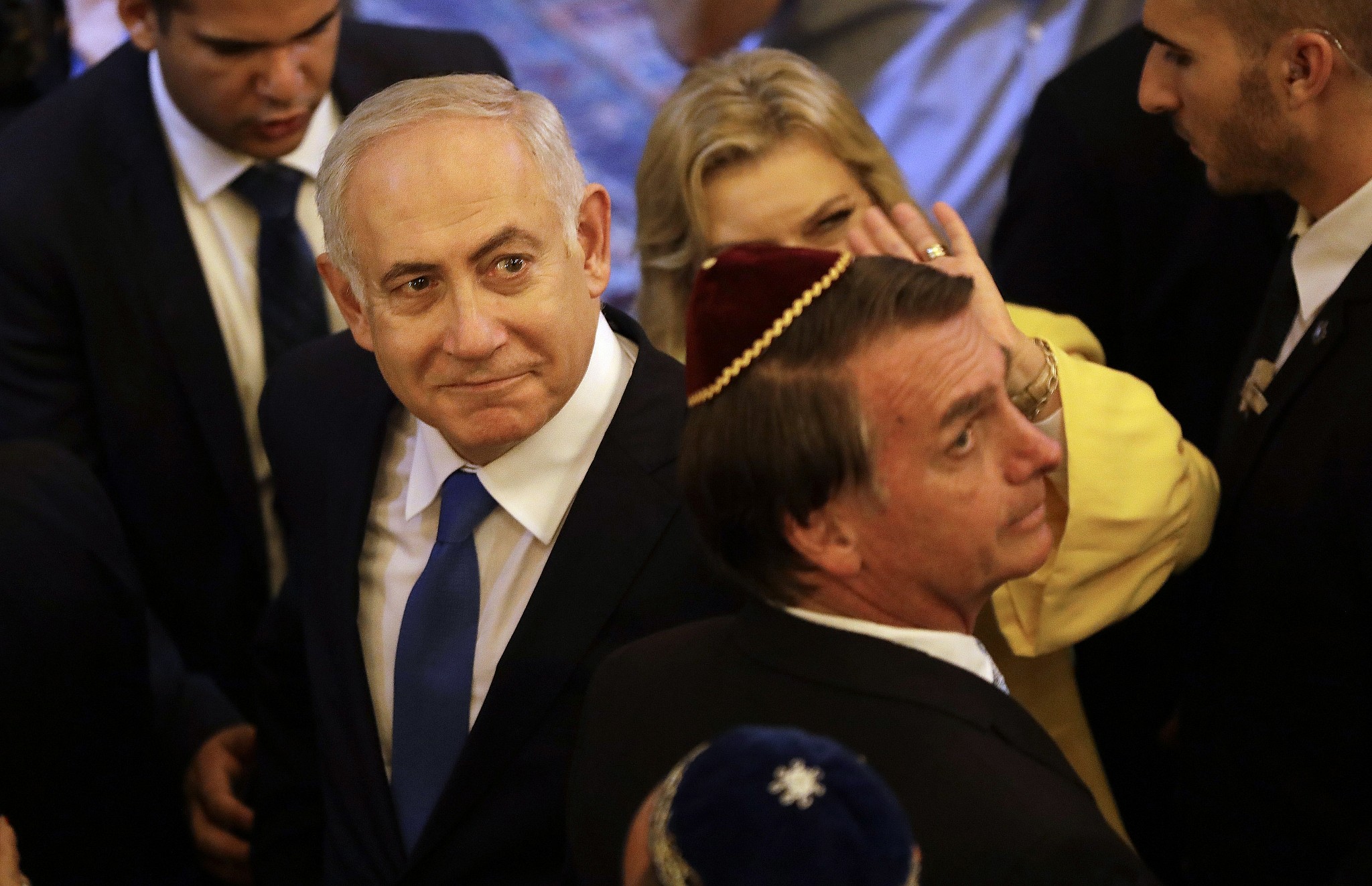 Israel's
Prime Minister Benjamin Netanyahu and
Brazil's President-elect Jair Bolsonaro give
a press conference after holding a meeting
at the Copacabana fort in Rio de Janeiro,
Brazil, on December 28, 2018.
Israel's
Prime Minister Benjamin Netanyahu and
Brazil's President-elect Jair Bolsonaro give
a press conference after holding a meeting
at the Copacabana fort in Rio de Janeiro,
Brazil, on December 28, 2018.
Israel’s Prime Minister Benjamin Netanyahu
(R) and Brazil’s President-elect Jair
Bolsonaro give a press conference after
holding a meeting at the Copacabana fort in
Rio de Janeiro, Brazil, on December 28,
2018.
When the blatantly racist Nation-State Basic
Law was announced last year, it was actually
criticised by some members of the Knesset as
being bad PR. The MKs need not have worried.
The EU expressed “concern” but there was no
suggestion that Israel’s extremely close
economic and political ties with Europe
would in any way be affected.
Nevertheless, Israel must be acutely aware
of the volatility of international politics,
and knows that the current alignment of
forces favouring unhindered expansion cannot
be relied upon to last forever. With legal
cases building up against him, Trump and his
entourage could be removed from the White
House. In the US, new voices of protest have
been raised in Congress against Israel’s
policies, and solidarity with the
Palestinian people has been expressed by
movements like Black Lives Matter.
Among American Jews, polls have shown waning
support for Israel, matched by a surge in
the membership of organisations like Jewish
Voice for Peace. Netanyahu may be happy to
form alliances with neo-fascist Eastern
European states steeped in anti-Semitism,
but this must horrify many of Israel’s
traditional supporters abroad.
Both in Europe and the US, the campaign of
boycott, divestment and sanctions (BDS) has
been gathering in strength, despite the
strenuous efforts of the pro-Israel lobby to
criminalise it. Victories such as Airbnb’s
decision not to advertise homestays in the
illegal settlements are naturally fought
tooth and nail by Israel with all the legal
and political resources at its disposal, but
this usually serves simply to bring the
underlying issues to the notice of a much
wider public. In Britain, the motions passed
by overwhelming majorities in the annual
conferences of the Trades Union Congress and
the Labour Party last autumn are clear
indicators of growing grassroots support for
the Palestinian people.
On the international scene, there is a very
strong prima facie case that could see
Israel brought before the International
Criminal Court for war crimes and crimes
against humanity. The Palestinians have
naturally been under huge pressure not to
pursue proceedings, but so far they have
held firm.
Since Israel and its supporters are unable
to refute the mountains of evidence of the
state’s gross violations of international
law, their only possible recourse has been
to silence the critics. In Britain
especially, the campaign to equate criticism
of Israel with anti-Semitism has focused on
getting the so-called IHRA definition of
anti-Semitism accepted, preferably with no
caveats to ensure freedom of speech. It is
no coincidence that the smearing of Labour
with accusations of anti-Semitism began with
the election of a party leader who has been
outspoken in his support for Palestinian
rights. Despite Labour’s reluctance to see
off such accusations, they have again
largely served to fuel public debate on
Israel’s interference in British politics
and the dangers that this represents.
Above all else, the sheer cruelty of
Israel’s actions throughout the Occupied
Palestinian Territories has become
impossible to ignore. As the Israeli General
Election approaches, the candidates are
vying with one another in their claims to be
the most brutal against Palestinians. Former
General Benny Gantz, a hot favourite to
succeed Netanyahu, brags about killing 1,364
Palestinians and flourishes his claim of
having “sent parts of Gaza back to the Stone
Age,” actions that Amnesty International has
defined as war crimes. When he was Foreign
Minister, Avigdor Lieberman called openly
for the expulsion or beheading of
Palestinian citizens who are “disloyal” to
the self-declared Jewish state.
Israel’s policies of expansion and expulsion
have been totally consistent from the
beginning. Only the public discourse has
changed, now reflecting these policies much
more openly and brazenly; it is on a winning
streak, but will it last? Whatever the
future holds, we must take this seriously,
and then decide whether we stand with the
rule of law and hold Israel accountable, or
the law of the jungle and let it continue to
act with impunity.
---
* Dr. Hilary Wise is a writer, academic and
activist for Palestinian rights.
** Photo by: LEO CORREA/AFP/Getty Images
Leave a Comment
Your Comment is Received .. Thank You
How much does someone reliant on the
mainstream media know about what is
happening in Israel and the Occupied
Palestinian Territories? A few more
Palestinians shot dead in Gaza – Israel
acting purely in self-defence, of course –
and that’s probably about it. But anyone who
reads reports by the UN, local NGOs or human
rights organisations, or indeed follows the
Israeli press, will see that Israel is
approaching a watershed moment.From Theodor Herzl, the founding father of political Zionism, to the present day the dream of a Greater Israel comprising, at least, all of historic Palestine has never been relinquished. “We shall endeavour to expel the poor population across the border unnoticed,” wrote Herzl. According to Israel’s first Prime Minister David Ben Gurion in 1938, “After we become a strong force, as the result of the creation of a state, we shall abolish partition and expand to the whole of Palestine.” The necessity of “transferring” the indigenous population to ensure a Jewish majority was also clearly articulated in Israel’s “Plan Dalet”, which was put into operation during the Nakba of 1948.
A two-state solution has been discussed endlessly ever since. It is still the avowed policy of the Palestinian Authority and is supported, at least nominally, by the EU and the US. However, the Israeli government doesn’t even bother to pay it lip service any more. In November, former minister Gideon Sa’ar said, “We cannot accept an Arab state in Judea and Samaria [the West Bank] regardless of who demands it.” At the same time, Deputy Foreign Minister Tzipi Hotovely said: “The two state solution proved that it failed and we need to repeat the word ‘stability’ today. The word ‘peace’ is not relevant in this era.” Prime Minister Benjamin Netanyahu has made it crystal clear that while he is in charge there will never be a Palestinian state in the West Bank.
Since the Oslo Accords in 1993, “transfer” has been well under way, with all Palestinians in Area C of the West Bank being herded into scattered pockets of territory, which together constitute only 10 per cent of what was once Palestine. To achieve a Greater Israel with a Jewish majority the next stage will presumably be the “transfer” of these Palestinians to Jordan or elsewhere, possibly together with Palestinian citizens of Israel, who are frequently referred to as a “demographic threat” to the “Jewishness” of the state of Israel.
On the ground, the work of terrorising the indigenous population is carried out partly by the illegal settlers, of whom there are now over 600,000 in East Jerusalem and the West Bank. Increasingly violent, they destroy property, attack local people including children going to school, spray-paint threats on the walls of Palestinian homes and throw Molotov cocktails at Palestinian cars, all under the benevolent gaze of the Israeli army. In 2018, there were 482 attacks by settlers, a threefold increase on the previous year.
The army itself harasses Palestinians at checkpoints, polices the Israeli-only highways that crisscross the West Bank and detains large numbers of adults and children, often without any due legal process.
At the same time, ingenious pseudo-legal pressure is brought to bear, in the form of closures and land seizures, house demolitions, severe restrictions on access to water and the imposition of permits of all kinds, be it to move around the Occupied Territories, to travel abroad or to build or extend a home. Palestinian citizens of Israel itself suffer from over 50 discriminatory laws and are increasingly forced to live in segregated areas, while in the Gaza Strip the besieged population struggles on the brink of total collapse.
All of Israel’s policies are plainly calculated to make life pretty well unbearable for the Palestinians, whether under direct Israeli rule or under military occupation. The Israeli public, meanwhile, has been thoroughly desensitised into accepting escalating levels of violence as “normal”. Twenty years ago, major incursions into Gaza brought Israelis out onto the streets of Tel Aviv in protest. Now, picnickers flock to vantage points overlooking the enclave to enjoy the spectacle. It seems that there are now no domestic constraints on what any Israeli government sees fit to visit upon the indigenous population.
On the world stage the political scene appears to favour Israel being able to play out the endgame without external interference. Trump and his fervently Zionist son-in-law arrived in the White House at just the right moment, implicitly recognising Jerusalem as Israel’s capital and openly encouraging the spread of the illegal settlements.
During Trump’s presidency to-date, planned settlement expansion has increased by 250 per cent. The US President has not only withdrawn all support from Palestinian refugees; he has also denied their refugee status altogether.
In the wider region, surrounding countries are either strongly aligned with US-Israel policy or in the throes of bitter internal conflicts. The Ramallah-based Palestinian Authority has long since been reduced to total subjugation by the occupying power, Israel.
Elsewhere, from Europe to Brazil, far right parties and regimes have expressed admiration and support for Israel’s racist policies. In embracing these new friends, Netanyahu has made it clear where he stands, in an increasingly polarised world.
Israel's
Prime Minister Benjamin Netanyahu and
Brazil's President-elect Jair Bolsonaro give
a press conference after holding a meeting
at the Copacabana fort in Rio de Janeiro,
Brazil, on December 28, 2018.Israel’s Prime Minister Benjamin Netanyahu (R) and Brazil’s President-elect Jair Bolsonaro give a press conference after holding a meeting at the Copacabana fort in Rio de Janeiro, Brazil, on December 28, 2018.
When the blatantly racist Nation-State Basic Law was announced last year, it was actually criticised by some members of the Knesset as being bad PR. The MKs need not have worried. The EU expressed “concern” but there was no suggestion that Israel’s extremely close economic and political ties with Europe would in any way be affected.
Nevertheless, Israel must be acutely aware of the volatility of international politics, and knows that the current alignment of forces favouring unhindered expansion cannot be relied upon to last forever. With legal cases building up against him, Trump and his entourage could be removed from the White House. In the US, new voices of protest have been raised in Congress against Israel’s policies, and solidarity with the Palestinian people has been expressed by movements like Black Lives Matter.
Among American Jews, polls have shown waning support for Israel, matched by a surge in the membership of organisations like Jewish Voice for Peace. Netanyahu may be happy to form alliances with neo-fascist Eastern European states steeped in anti-Semitism, but this must horrify many of Israel’s traditional supporters abroad.
Both in Europe and the US, the campaign of boycott, divestment and sanctions (BDS) has been gathering in strength, despite the strenuous efforts of the pro-Israel lobby to criminalise it. Victories such as Airbnb’s decision not to advertise homestays in the illegal settlements are naturally fought tooth and nail by Israel with all the legal and political resources at its disposal, but this usually serves simply to bring the underlying issues to the notice of a much wider public. In Britain, the motions passed by overwhelming majorities in the annual conferences of the Trades Union Congress and the Labour Party last autumn are clear indicators of growing grassroots support for the Palestinian people.
On the international scene, there is a very strong prima facie case that could see Israel brought before the International Criminal Court for war crimes and crimes against humanity. The Palestinians have naturally been under huge pressure not to pursue proceedings, but so far they have held firm.
Since Israel and its supporters are unable to refute the mountains of evidence of the state’s gross violations of international law, their only possible recourse has been to silence the critics. In Britain especially, the campaign to equate criticism of Israel with anti-Semitism has focused on getting the so-called IHRA definition of anti-Semitism accepted, preferably with no caveats to ensure freedom of speech. It is no coincidence that the smearing of Labour with accusations of anti-Semitism began with the election of a party leader who has been outspoken in his support for Palestinian rights. Despite Labour’s reluctance to see off such accusations, they have again largely served to fuel public debate on Israel’s interference in British politics and the dangers that this represents.
Above all else, the sheer cruelty of Israel’s actions throughout the Occupied Palestinian Territories has become impossible to ignore. As the Israeli General Election approaches, the candidates are vying with one another in their claims to be the most brutal against Palestinians. Former General Benny Gantz, a hot favourite to succeed Netanyahu, brags about killing 1,364 Palestinians and flourishes his claim of having “sent parts of Gaza back to the Stone Age,” actions that Amnesty International has defined as war crimes. When he was Foreign Minister, Avigdor Lieberman called openly for the expulsion or beheading of Palestinian citizens who are “disloyal” to the self-declared Jewish state.
Israel’s policies of expansion and expulsion have been totally consistent from the beginning. Only the public discourse has changed, now reflecting these policies much more openly and brazenly; it is on a winning streak, but will it last? Whatever the future holds, we must take this seriously, and then decide whether we stand with the rule of law and hold Israel accountable, or the law of the jungle and let it continue to act with impunity.
---
* Dr. Hilary Wise is a writer, academic and activist for Palestinian rights.
** Photo by: LEO CORREA/AFP/Getty Images
Leave a Comment
Your Comment is Received .. Thank You
Advertise With Us